

By B&A Farms
Our existing post on choosing the right B&B shade tree fit for Magnolia, TX covers species selection and root ball considerations in depth, including how the area’s heavy clay soils and punishing summer heat shape every sizing decision we make. What it does not cover is the logistics side of getting those trees onto an active project site in a neighboring market. Tomball sits about 25 miles southeast of our farm, and the questions we get from contractors and developers working there tend to focus less on which tree and more on how the whole delivery and installation process actually unfolds. That is the gap this article fills. If you are coordinating shade tree delivery for a Tomball project and need to understand the process from order to ground, keep reading.
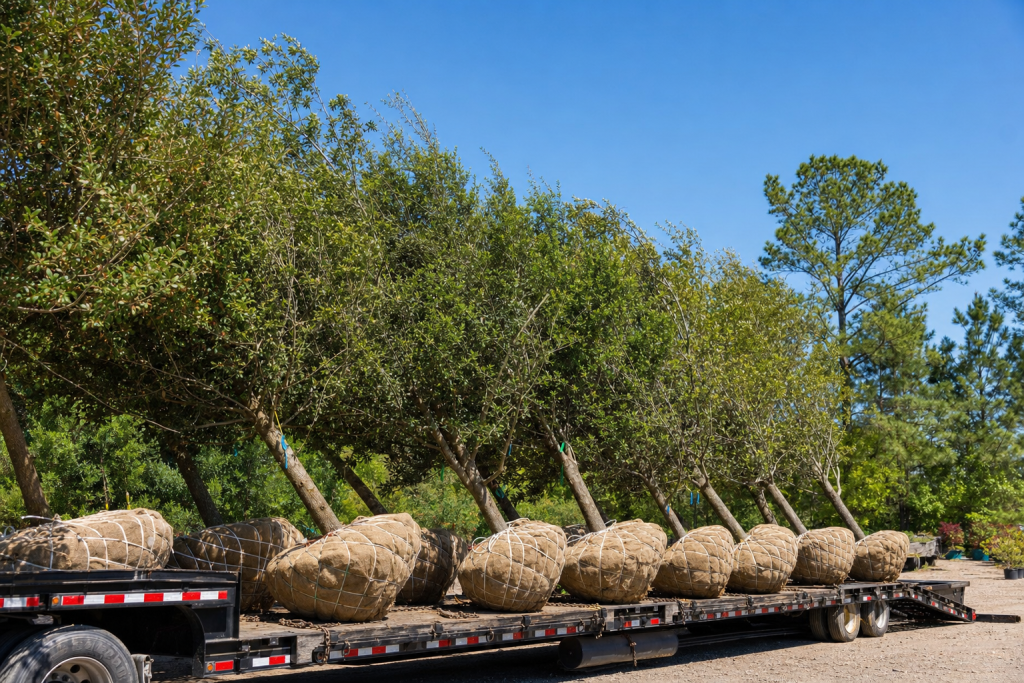
B&A Farms supplies and delivers balled and burlapped shade trees directly to project sites in Tomball, TX. Orders are available for contractors, developers, and large residential projects. Trees are grown and sourced from our farm in Richards, TX, and delivered via flatbed to your site with coordination handled by our team from start to finish. Sizing, species, and delivery scheduling are all confirmed before the truck rolls.
Key Takeaways
- B&A Farms delivers balled and burlapped shade trees directly to Tomball project sites, including commercial developments and large residential installs.
- Tomball’s clay-heavy soil and high July heat make species selection and root ball sizing critical decisions, not afterthoughts.
- Our team coordinates delivery scheduling around your site timeline, not a fixed calendar.
- Contractors working near FM 2920 and the Tomball Parkway corridor can expect straightforward flatbed access to most active job sites.
- Trees are delivered in balled and burlapped form, which supports transplant success in Tomball’s compacted and moisture-variable soils.
Why Tomball’s Site Conditions Shape Every Tree Order
Tomball does not have uniform soil. Anyone who has worked a site near Willow Creek Farms or out along Telge Road knows that you can hit dense clay within the first six inches, then find a sandier layer below that, sometimes within the same lot. That variability matters when you are specifying shade trees, because a root ball sized for one soil type can fail in another if the drainage profile is wrong.
July in this part of Harris and Montgomery counties is not forgiving. Ground temperatures at the surface can exceed 130 degrees, and trees that arrive stressed, poorly balled, or undersized for the canopy coverage a project needs will struggle through the rest of the summer. That is why we do not treat shade trees delivered to projects Tomball TX as a simple drop-and-go transaction. Our team reviews the site conditions before confirming species and caliper so that what arrives on the truck is actually matched to where it is going in the ground.
For commercial projects near the Tomball Tollway or the FM 2920 development corridor, the additional consideration is often immediate canopy presence. Developers in that market are frequently working against HOA requirements or municipal landscaping ordinances that specify minimum caliper sizes. We supply trees that meet those specs, and we can document sizing for permit packages when needed. You can see more about how our delivery and project services work across different project types.
How Tomball Shade Tree Delivery Works
The process starts with a conversation, not a catalog. When a contractor or developer contacts us about shade tree delivery in Tomball, the first thing we want to know is the site address, the number of trees, the target caliper or height, and the planting window. From there, we confirm availability from our inventory, discuss species options that are appropriate for the site, and schedule delivery around your timeline.
Flatbed delivery to Tomball is straightforward from our Richards farm. We have run trees to sites near Tomball High School, along Huffmeister Road, and into the newer subdivisions pushing north toward Spring Creek. Access is rarely a problem, but we do ask about overhead clearance and whether the site has a staging area. A loaded flatbed carrying 15 to 20 balled trees needs room to maneuver, and a little coordination upfront saves everyone time on delivery day.
Balled and burlapped trees are the standard for this kind of project delivery, and for good reason. The intact root ball protects the tree during transport and gives it the best possible start in Tomball’s variable soil. If you want a deeper look at how that process works mechanically, our post on how balled and burlapped tree installation actually works breaks it down step by step. And for contractors who have worked with us on Montgomery County projects, the process here is similar to what we covered in our Montgomery TX contractor guide.
Which Species Hold Up Best in Tomball’s Climate?
Live oaks are the most requested shade tree we deliver to Tomball projects, and that makes sense. They are adapted to Southeast Texas heat, tolerate clay soil, and provide the dense canopy coverage that both homeowners and commercial developers want. Southern red oaks and Shumard oaks are strong alternatives for sites where faster vertical growth is a priority. Cedar elms are worth considering for tighter planting areas near structures, since their root systems tend to be less aggressive than live oaks at maturity.
What we steer people away from in this market are species that need consistently well-drained soil. Tomball’s wet winters and dry, brutal summers create a moisture cycle that punishes trees not adapted to that swing. Our wholesale tree inventory focuses on species that are proven performers in Southeast Texas conditions, and we are upfront when a requested species is a poor fit for a particular site.
Post-planting care also matters more than most project managers expect. We have a resource on care for newly planted shade trees that is worth sharing with whoever is responsible for the site after installation, because the first 90 days in Tomball’s summer heat are when most transplant failures happen.
Frequently Asked Questions
Does B&A Farms deliver shade trees directly to job sites in Tomball, not just to a staging yard?
Yes. We deliver directly to the project site in Tomball. Our flatbed trucks are equipped to handle active construction sites, and we coordinate delivery timing with your site schedule. We do not require you to arrange secondary transport from a staging location.
What is the minimum order size for Tomball shade tree delivery?
We work primarily with contractors, developers, and large residential projects rather than single-tree retail orders. Minimum order quantities depend on tree size and species. Contact our team directly to discuss your project volume and we can confirm whether it fits our delivery model.
How far in advance do I need to place an order for Tomball delivery?
Lead times vary by species and caliper, especially during peak planting windows. In July, inventory on larger caliper live oaks moves quickly. We recommend reaching out as early in your project timeline as possible. Two to four weeks of lead time is a reasonable baseline, though some orders can be turned around faster depending on availability.
Can B&A Farms supply documentation for trees that need to meet Tomball or Harris County landscaping ordinance requirements?
Yes. We can provide documentation on tree sizing and species for permit packages. If your project has specific caliper or height requirements tied to a municipal or HOA ordinance, share those specs with us upfront and we will confirm whether our available inventory meets them before the order is placed.
Tomball is growing fast, and the pressure to deliver finished, shaded sites on tight timelines is real for every contractor and developer working that market right now. We have been supplying and delivering trees to projects across this part of Texas long enough to know that the difference between a successful install and a failed one usually comes down to what happened before the tree ever left the farm. If your project needs tree delivery handled by people who know this region, reach out to our team and let us work through the details with you.

